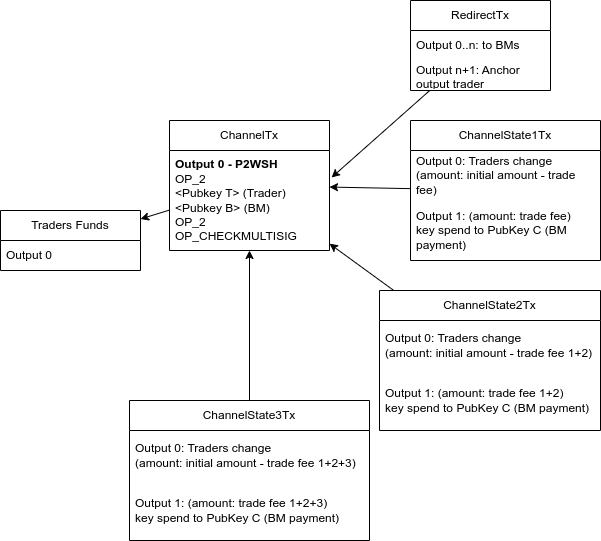
This outlines a concept for trade fee payment using on-chain techniques. The Solution presented includes ‘unidirectional payment channels’ as described in the book ‘Mastering Bitcoin’ and silent payments (BIP-352). To understand this article, you probably need an understanding of these two technologies.
BM – Burning master is a contributor which collects compensations through this mechanism. Alice – the trader which wants to pay fees through a Payment channel Bob – the peer trader, which does a trade with Alice.
Alice broadcasts a transaction to a multisig, between Alice and a BM (ChannelTx). If the Alice shall be able to initiate the channel without communicating with the BM, Alice will not be able to do the multisig using MuSig2. Instead, she will need to use a script. For the script she needs to have a public key of the BM. This could be provided using a silent payment, see BIP-352. When opening the channel, Alice has to decide which capacity the channel gets. The channel size has a limit. For max privacy we use the segwit v0 multisig script as this is mostly used.
For each trade Alice makes, she uses the trade channel to pay the trade fees. To do so, she will create a transaction from the channel multisig to an address of the BM (getting address using silent payment). Then she presigns the transaction with his key. Since it’s a multisig, his key is not enough, but the BM can complete it at any time. For each trade fee Alice signs another transaction, the amount must be the amount of the last transaction plus the fee.
Alice will send Bob the following message:
Bob verifies the message by:
He does not verify the rest, especially not against previous transaction and double spend. Although it’s unnecessary that Bob verifies the channel update transaction’s beneficiary is the intended BM, because that can be made later on by the BM itself. A
After verification, Bob will will resend the message as a bisq mailbox message to the BM. The BM does not need to be online and can verify his part at any later point in time.
Whenever the BM comes online, he will collect all messages and tries to decrypt them. He can decrypt all messages to him. From those messages he learns which channel-opening Txids are for him. He verifies all messages with the same Txid and checks if the channel update transactions are correct and the amounts add up properly. If not, he signs and broadcasts the RedirectTx, which will send all funds to the DAO for arbitration. Bob has posted the channel update transactions which he validated. So if they don’t add up, or there are too many transactions, the arbitrator can decide if there was a fraud going on.
In the happy path the BM will close the channel when the channel is used up or the BM is asked to close the channel by Alice. After verification, he will issue the latest channel state transaction and that ends this protocol.
Alice cannot close the channel without the BM. Once a BM gets to know
a new channel has opened, the BM sends a signature for the
RedirectTx to Alice. With it Alice can send the funds at
any time to the DAO, which will need to resolve the fund with the BM.
However, if the BM is not responsive, Alice can only use up the channel
capacity for further trade fees. Alice may complain to the DAO and such
a complaint would have consequences for the BM.
Since Bob does not have the historical data of the ChannelStateTxs he
has no way to see if Alice does a double spend or not. Only the BM can
check the correctness of the ChannelStateTxs and therefore make sure
Alice is not double spending. If the BM is not online, this can lead to
double spends not detected immediately. They will be detected later on
when the BM comes online, at which point the BM can send the funds to
the DAO using the RedirectTx. The potential gain for
someone to do this is low, as he gets only access to the fees and the
risk of being penalized is not calculatable. (Unless for some reason he
knows that the BM will not come online anymore.)
Bob needs to make sure that the channel-opening transaction is correct and is actually on the chain. He verifies:
Alice needs to prove to Bob that the used Public key B is actually a silent payment address of the BM (derived from S). The BM needs to publish his silent payment address S to the public. According to BIP-352, see also this explainer, the address for a silent payment is calculated via: (1)\hspace{5pt} B = S + hash(a \cdot S) \cdot G where
BIP-374 defines a DLEQ (zero-knowledge discrete logarithm equality proof) to prove that the calculated address B is actually the correct address derived from silent payment S. BIP-375 describes how to send a silent payment with PSBTs.
However, since I could not find rust implementations of these BIPs, I propose to use a short-cut. Looking at the equation given in (1), Alice sends a\cdot S to Bob. Sending a\cdot S does not compromise any knowledge about a. Bob then can calculate B using the formula (1) and uses that as the payment address in the transaction.
This calculation of B by using a \cdot S from Alice does not guarantee that the result is actually a silent payment address of the BM. However, Alice cannot know the secret key of S + hash(a \cdot S) \cdot G no matter which value for a \cdot S he will send to the second trader. So worst-case Alice can trick Bob into an address which is not spendable by anyone. In any case, Alice will not have any benefit.